Product Designer


Creating 0-to-1 care experiences and data visualization for pet wellness
Service Structuring
Feature Prototyping
Scalable Design
Work in Progress
*Please note that due to NDA restrictions of upcoming unreleased features, the full experience cannot be shown here. Please contact me for a complete demonstration.
What I Faced
Too many steps, no flow
Pet health routines especially for caregivers managing pets with diabetes were fragmented, with tasks spread across disconnected tools, leaving caregivers without a clear way to track patterns or stay confident, and giving vets limited visibility into day-to-day care.
What I Did
From care flows
to data clarity
I designed a connected, insight-driven experience that simplifies daily care. I mapped the multi-user ecosystem, created clear end-to-end flows, built scalable UI patterns, and developed interaction prototypes while aligning design decisions with technical feasibility.
What it became
A Clear, MVP-Ready Care Experience
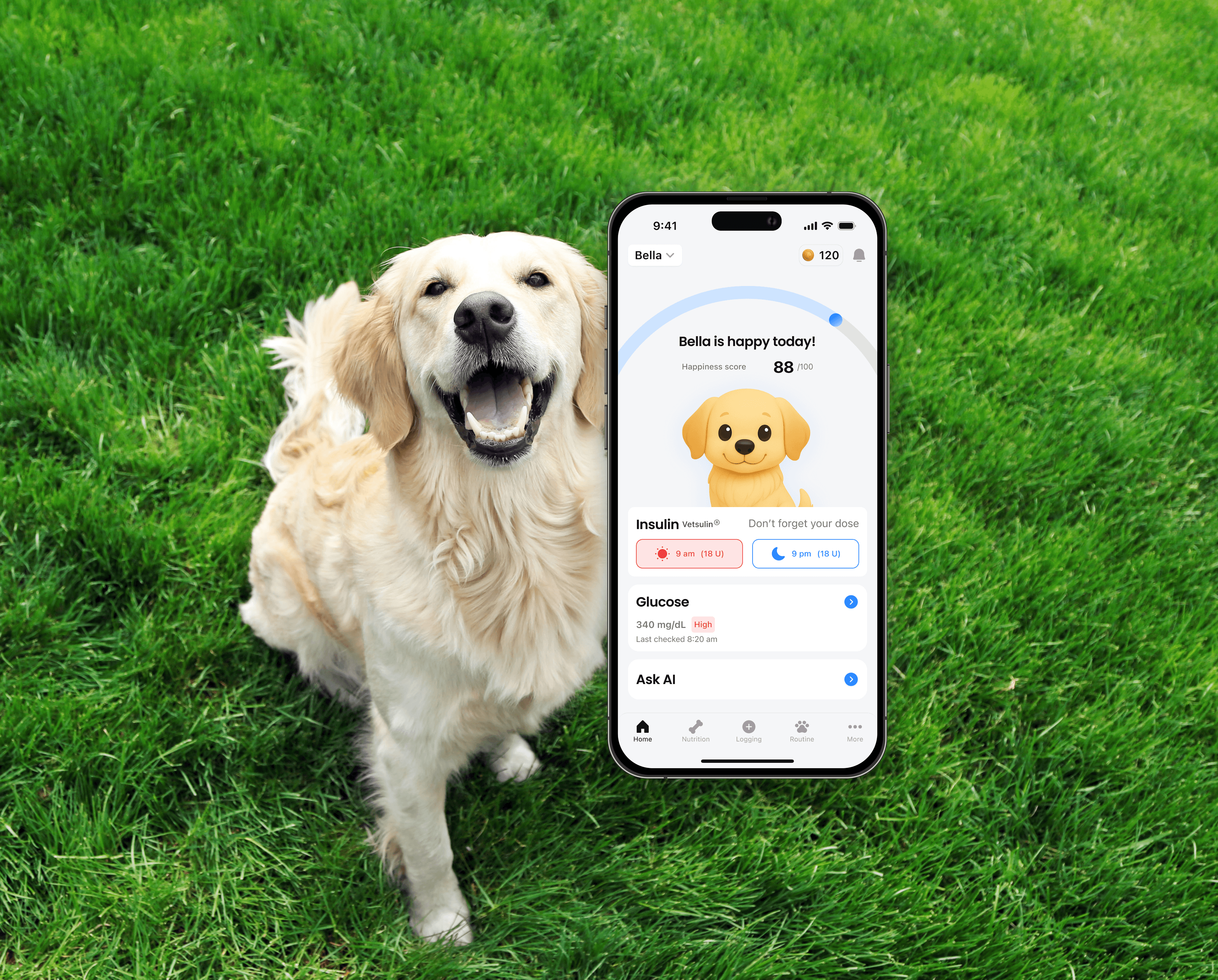
The result was a clear, MVP-ready experience built specifically for caregivers supporting pets with diabetes, connecting core routines into one guided flow.
Diabetes Care flow
Insulin logging (dosage, time)
Blood glucose tracking with visual history
Alerts for out-of-range glucose levels
Nutrition Logging flow
Insulin logging (dosage, time)
Blood glucose tracking with visual history
Alerts for out-of-range glucose levels
AI Chatbot Flow
Insulin logging (dosage, time)
Blood glucose tracking with visual history
Alerts for out-of-range glucose levels

Creating 0-to-1 care flows
and clear insights for pet wellness
System Mapping
Interaction prototyping
Design Scalability
Work in Progress
*Please note that due to NDA restrictions of upcoming unreleased features, the full experience cannot be shown here. Please contact me for a complete demonstration.
What I Faced
Too many steps, no flow
Pet health routines especially for caregivers managing pets with diabetes were fragmented, with tasks spread across disconnected tools, leaving caregivers without a clear way to track patterns or stay confident, and giving vets limited visibility into day-to-day care.
What I Did
Made the flow clear
I designed a connected, insight-driven experience that simplifies daily care. I mapped the multi-user ecosystem, created clear end-to-end flows, built scalable UI patterns, and developed interaction prototypes while aligning design decisions with technical feasibility.
What it became
A Clear, MVP-Ready Care Experience
The result was a clear, MVP-ready experience built specifically for caregivers supporting pets with diabetes, connecting core routines into one guided flow.
Diabetes Care flow
Insulin logging (dosage, time)
Blood glucose tracking with visual history
Alerts for out-of-range glucose levels
Nutrition Logging flow
Records daily meals and treats with visual summaries
Calculates macro distribution and calorie trends
Provides recommendations for balanced intake
AI Chatbot Flow
AI-driven feedback based on real-time pet data
Suggests actionable tips for diet, hydration, and activity balance
Delivers empathetic, natural responses to support daily care
How I Approached the UX
Building a Clear, Guided Care System
I mapped how real care unfolds and turned scattered routines into structured flows, shaped by shared patterns and validated through fast prototyping.
Research Insights
Research Insights
When routines scatter
Tasks spread across tools and moments create friction, making even simple care feel overwhelming.
I examined how daily care actually unfolds to see where timing and tasks break down.
Although research began with obesity, real-world insights showed that diabetes caregivers had the most urgent unmet needs, which shaped the MVP focus.
I examined how daily care actually unfolds to see where timing and tasks break down.
Although research began with obesity, real-world insights showed that diabetes caregivers had the most urgent unmet needs, which shaped the MVP focus.


Qualitative insights gathered from caregiver communities and interviews


Visualizing the full care timeline to uncover hidden pain points across daily glucose, meals, walks, and medication.
Daily Routine Pain Points
Timing conflicts between medication, meals, and activity
Scattered glucose checks that make patterns hard to interpret
High cognitive load from managing many interdependent tasks
System Mapping
System Mapping
Where care disconnects
Caregivers, pets, and vets rely on the same information, but their tools and moments do not line up, creating gaps in guidance and visibility.
I mapped the end-to-end care journey to understand where information breaks, where patterns are lost, and where decisions become inconsistent. This clarified the structural gaps that make daily care difficult for both caregivers and vets.
Care Journey Map


Journey map illustrating the current care process and its gaps across logging, insights, vet review, and treatment adjustments.
Key Findings
3 of 5 stages have critical pain points affecting care quality
No automation between data collection and insight generation
Limited connectivity between caregiver and vet outside appointments
Design Principles
Design Principles
When structure brings clarity
When structure
brings clarity
Caregivers managing diabetic pets face a routine that depends heavily on timing and correct decisions, yet the tasks are scattered across different tools and the right next step isn’t always obvious. Without clear guidance, even small timing mistakes can create risk or break the routine.
BEFORE
Fragmented Care Tasks
Check Glucose
When? How often?
Feed Pet
How much?
Give Insulin
Adjust dose?
Track Data
What does it mean?
No sequence
Uncertain timing
Guesswork
To reduce this cognitive load, I needed a design approach that reorganizes glucose checks, meals, medication, and activity into one predictable flow. A guided structure helps caregivers know what to do, when to do it, and why it matters, turning fragmented actions into a safe, confident daily rhythm.
AFTER
Guided Flow System
Input
Glucose
Meal
Insulin
Activity
Guide
Trend Analysis
Pattern Detection
Risk Alerts
AI Insights
Action
Insulin Dose
Meal Timing
Activity Plan
Vet Check
Review
Daily Reports
Weekly Trends
Vet Sharing
Goal Tracking
Clear sequence
Automated timing
Smart guidance
Once the overall flow was structured, I defined the core rules that determine how the system guides each step. These logic patterns turn raw data into clear and safe recommendations that keep the routine predictable. The logic spans glucose responses, meal timing, activity safety, and insulin scheduling, forming the foundation of the guided experience.
Core Decision Logic
Insulin Due Soon
IF
Scheduled dose in < 30 minutes
IF
THEN
Show reminder with safe activity window
High Glucose Detected
IF
Glucose level > 250 mg/dL
IF
THEN
Recommend delaying walk until stable
Late Meal Detected
IF
Meal logged > 1 hour late
IF
THEN
Auto-adjust schedule and notify caregiver
Low Glucose Detected
IF
Glucose level < 80 mg/dL
IF
THEN
Adjust meal timing and increase portion
Although the system includes multiple decision rules, the MVP prioritized insulin timing because it has the highest safety impact and is the most critical anchor for daily care.
Guided Flow Design
Guided Flow Design
When clear steps replace guesswork
Caregivers managing diabetic pets face a routine that depends heavily on timing and correct decisions, yet the tasks are scattered across different tools and the right next step isn’t always obvious. Without clear guidance, even small timing mistakes can create risk or break the routine.
Why I Started with Insulin
Insulin timing carries the most sensitive and error-prone decisions in diabetic care. By designing this flow first, I could validate whether the guidance model truly reduced cognitive load and helped caregivers act with confidence.
A Calm, State-Based Flow
Instead of minute-level countdowns, the interface uses a predictable progression:
Not Yet → Get Ready → Give Now
This reduces time pressure while still keeping the routine safe and easy to follow.
Instead of minute-level countdowns, the interface uses a predictable progression:
Not Yet → Get Ready → Give Now
This reduces time pressure while still keeping the routine safe and easy to follow.
Next insulin shot
in
12
hours
Not Yet
Not Yet State
12h → 4h before
Early in the day, the experience stays in a non-actionable state. Only broad hour ranges are shown to avoid timing pressure.
State Message: “12 hours left” / “4 hours left”
Button: Not Yet (disabled)
• No minute-level countdowns
• Calm, low-attention mode
• Clearly signals “nothing to do yet”Next insulin shot
in
3
hours
Get Ready
Get Ready State
3h → 30min before
As dosing approaches, the UI shifts into a preparation state. Simplified time cues help caregivers anticipate the routine without stress.
State Message: “3 hours left” / “1 hour left”
Button: Get Ready (disabled)
• CTA still disabled
• Predictable time cues
• Minimal numbers for a calm experienceNext insulin shot
It’s time

Give Now
Give Now State
–30 min → +30 min
When the action window begins, time labels disappear. The interface switches to clear guidance, activating the “Give Now” CTA.
State Message: “It’s Time”
Button: Give Now (active)
• No time display
• Simple, actionable state
• Covers the entire safe window
While insulin operates on a time-based model, glucose and nutrition follow their own data-driven triggers.
They still integrate into the same state-based interaction pattern for a unified experience.
While insulin operates on a time-based model, glucose and nutrition follow their own data-driven triggers.
They still integrate into the same state-based interaction pattern for a unified experience.
Different rules, same interaction pattern
Different rules,
same interaction pattern
Glucose Check
Last Glucose checked
340
mg/dL
High
8:20 am
3 readings left to see your glucose chart
Data-triggered guidance based on actual glucose reading
Nutrition Log
Calories Fed
650
/ 1000 kcal
Fiber is low, include veggies next meal
Meal entries update the care state and keep the routine consistent
Interaction Prototyping
When clarity is validated
I used interaction prototypes to refine timing, transitions, and the micro-interactions that shape how guidance is perceived.
Quick usability checks helped validate clarity, reduce pressure, and fine-tune when each state shift should occur.
I used interaction prototypes to refine timing, transitions, and the micro-interactions that shape how guidance is perceived.
Quick usability checks helped validate clarity, reduce pressure, and fine-tune when each state shift should occur.


Focus areas
Transition refinement
Smoother shifts between states
Transition refinement
Smoother shifts between states
Timing clarity
Predictable cues without stress
Timing clarity
Predictable cues without stress
Micro-interactions
Calm, supportive experience
Micro-interactions
Calm, supportive experience
Scalable System Design
When one pattern scales everything
The MVP begins with insulin but the system was built to support more routines. Each routine uses different triggers such as time values or events but the experience stays unified through one state based interaction pattern.
The diagram below summarizes this unified model.
The MVP begins with insulin but the system was built to support more routines. Each routine uses different triggers such as time values or events but the experience stays unified through one state based interaction pattern.
The diagram below summarizes this unified model.
Care Journey Map


Journey map illustrating the current care process and its gaps across logging, insights, vet review, and treatment adjustments.
Unified Interaction System


What I designed
A System-First Foundation
for Scalable Routines
A System-First Foundation
for Scalable Routines
Even though the MVP begins with insulin, the experience needed to support more than one routine. Instead of designing separate flows, I built a unified interaction system that time-based, value-based, and event-based routines can all plug into.
Components
Components
Logging Pattern Blueprint
To keep the experience predictable across insulin, glucose, and nutrition, I designed a reusable component structure for all routine logs. Each routine has a different trigger, but the logging → feedback → timeline update pattern remains the same.


System
Feedback Loop Structure
Once an event is logged, each routine follows the same loop:
Log Event → Instant Feedback → Care Timeline Update.
This keeps the product predictable even when routines differ in complexity.


Current Status & Next Steps
Now
Core MVP flows (insulin, glucose, nutrition) defined and prototyped
Unified interaction pattern + state logic fully established
Core MVP flows (insulin, glucose, nutrition) defined and prototyped
Unified interaction pattern + state logic fully established
Next
Extend to preventive care & activity routines
Validate clarity with usability rounds and refine multi-caregiver flow
Extend to preventive care & activity routines
Validate clarity with usability rounds and refine multi-caregiver flow
How I Approached the UX
Building a Clear,
Guided Care System
I mapped how real care unfolds and turned scattered routines into structured flows, shaped by shared patterns and validated through fast prototyping.
impact (so far)
Translated complex care routines into predictable, state-based flows that reduce cognitive load.
Demonstrated end-to-end ownership as the sole designer shaping both product direction and system structure.
Built a scalable interaction system that unifies time-based, value-based, and event-based routines.
Full outcomes and usability learnings will be documented post-launch.